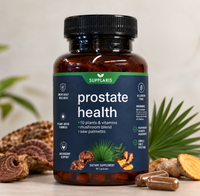

Saw palmetto and beta-sitosterol are two of the most common ingredients in men's prostate-support formulas. They are often listed side by side, and many people assume they are the same thing. They are not. This guide explains where each one comes from, how researchers think they work, what the clinical studies actually found, and how to think about them as part of a daily routine.
Where they come from
Saw palmetto (Serenoa repens) is a small palm that grows in the southeastern United States. Supplements use an extract of its dark berries, which are rich in fatty acids and naturally occurring plant sterols. Most clinical studies used a standardized "lipidosterolic" extract, usually at around 320 mg per day.
Beta-sitosterol is not a plant. It is a single compound, a phytosterol, found in many plant foods, including nuts, seeds, avocados, soy and vegetable oils. Supplements typically concentrate it from sources such as pine or soy. Interestingly, beta-sitosterol is also one of the sterols naturally present in saw palmetto berries, which is part of why the two are often discussed together.
How researchers think they work
Saw palmetto has been studied mainly for its possible influence on androgen metabolism. Laboratory research suggests some extracts may affect 5-alpha-reductase, the enzyme that converts testosterone into dihydrotestosterone (DHT). Researchers have also looked at effects on inflammatory signaling in prostate tissue. These mechanisms come mostly from lab and animal work, so they do not prove an effect in people.
Beta-sitosterol is structurally similar to cholesterol. Proposed mechanisms include effects on prostaglandin signaling and on cell membranes. As with saw palmetto, the exact mechanism in humans is not settled.
What the clinical research found
The research picture for the two ingredients is different, and it is worth being precise.
Saw palmetto. Early, smaller trials reported improvements in urinary comfort in men with lower urinary tract symptoms. Later, larger and better-controlled studies were less positive. A 2006 trial in the New England Journal of Medicine (Bent et al.) and a 2011 dose-escalation trial in JAMA (Barry et al.) did not find a meaningful difference versus placebo, and a 2012 Cochrane review (Tacklind et al.) reached a similar conclusion. Saw palmetto has generally been well tolerated in these studies.
Beta-sitosterol. A Cochrane review of beta-sitosterol trials (Wilt et al., 1999) found that men taking it reported improvements in urinary symptom scores and urine flow compared with placebo. One frequently cited trial is Berges et al., published in The Lancet in 1995. The reviewers noted the trials were relatively short and that long-term data were limited.
In short: beta-sitosterol has a smaller but more consistently positive evidence base for urinary comfort, while the larger, more recent saw palmetto studies have been mixed to negative. Neither ingredient is a substitute for medical evaluation.
Side by side
- Type: saw palmetto is a whole-berry extract; beta-sitosterol is a single plant sterol.
- Typical amounts studied: about 320 mg/day of saw palmetto extract; roughly 60 to 130 mg/day of beta-sitosterol in the main trials.
- Evidence: mixed for saw palmetto; smaller but more favorable for beta-sitosterol.
- Tolerability: both were generally well tolerated in studies; mild stomach upset is the most common complaint.
Why formulas often combine them
Because they come from different sources and are thought to work in different ways, many men's formulas include both, often alongside nutrients such as zinc, selenium and lycopene. Combination products are rarely studied as a whole, so the evidence above applies to the individual ingredients, not to any specific blend.
Practical tips
- Check the label for the amount of each ingredient, not just whether it is present.
- Give any routine several weeks and be consistent; most trials ran for 4 weeks or longer.
- New or worsening urinary symptoms should always be checked by a doctor, because they can have many causes.
- If you take prescription medication, especially for the prostate, hormones or blood thinning, ask your doctor or pharmacist first.
Sources
- Bent S, et al. Saw palmetto for benign prostatic hyperplasia. N Engl J Med. 2006;354(6):557-566.
- Barry MJ, et al. Effect of increasing doses of saw palmetto extract on lower urinary tract symptoms: a randomized trial. JAMA. 2011;306(12):1344-1351.
- Tacklind J, et al. Serenoa repens for benign prostatic hyperplasia. Cochrane Database Syst Rev. 2012;12:CD001423.
- Wilt T, et al. Beta-sitosterols for benign prostatic hyperplasia. Cochrane Database Syst Rev. 1999;(2):CD001043.
- Berges RR, et al. Randomised, placebo-controlled, double-blind clinical trial of beta-sitosterol in patients with benign prostatic hyperplasia. Lancet. 1995;345(8964):1529-1532.
These statements have not been evaluated by the Food and Drug Administration. This content is for general information only and is not intended to diagnose, treat, cure, or prevent any disease. Talk to your healthcare provider before starting any supplement.