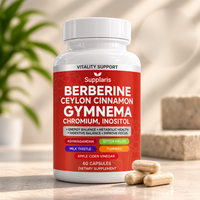

Berberine has become one of the most talked-about supplement ingredients of the last few years. You will see it described online in very big terms. This article sets the hype aside and looks at what berberine is, how researchers think it works, what the clinical studies found, and who should be careful with it.
What is berberine?
Berberine is a bright yellow compound found in the roots and bark of several plants, including barberry (Berberis vulgaris), goldenseal and Chinese goldthread. It has a long history in traditional Chinese and Ayurvedic practice. Modern supplements usually provide berberine hydrochloride, often in doses of 500 mg taken two or three times a day with meals, which is the pattern used in many studies.
How researchers think it works
Much of the interest in berberine comes from lab research showing that it activates AMPK (AMP-activated protein kinase), an enzyme sometimes called the body's "metabolic master switch." AMPK helps regulate how cells take up and use glucose and fat. Berberine also appears to interact with the gut microbiome and with how the liver handles cholesterol. A 2016 review in Phytotherapy Research (Imenshahidi and Hosseinzadeh) summarizes these mechanisms. As always, mechanisms seen in the lab do not automatically translate into effects in people.
What the clinical research found
Berberine has been tested in a fair number of human trials, many of them in China and many in people with metabolic conditions who were under medical care.
- A 2012 meta-analysis (Dong et al.) pooled 14 randomized trials and found berberine was associated with improvements in fasting glucose and lipid markers compared with lifestyle changes alone or placebo.
- A 2015 meta-analysis in the Journal of Ethnopharmacology (Lan et al.) reached broadly similar conclusions across 27 trials, while noting that many studies were small and of mixed quality.
The honest summary: the research is promising, but most trials were short, many were small, and they were mostly done in people with diagnosed conditions. Berberine is not a replacement for prescribed medication, diet, exercise or regular check-ups.
Berberine and everyday wellness
For healthy adults, berberine is usually discussed as one part of a routine that supports normal glucose metabolism, alongside the basics that matter most: balanced meals with fiber and protein, regular movement, good sleep and a healthy weight. Many formulas pair berberine with ingredients such as Ceylon cinnamon, which has its own history of culinary and traditional use.
Safety and interactions
- Digestive effects such as cramping, constipation or diarrhea are the most commonly reported side effects. Taking berberine with meals and splitting the dose can help.
- Drug interactions. Berberine can slow the activity of several liver enzymes (CYP450) that break down medications (Guo et al., 2012). This can change the levels of other drugs in your body.
- Blood sugar medication. If you take medication that lowers blood sugar, combining it with berberine may increase the effect. Do not start berberine without talking to your doctor.
- Who should avoid it: people who are pregnant or breastfeeding, and anyone under 18.
Key takeaways
- Berberine is a plant compound with a long traditional history and a growing body of research.
- Its best-known mechanism is activation of AMPK, which is involved in energy metabolism.
- Human studies are encouraging but mostly short and in people with existing conditions.
- It interacts with medications, so check with a healthcare professional first.
Sources
- Dong H, et al. Berberine in the treatment of type 2 diabetes mellitus: a systemic review and meta-analysis. Evid Based Complement Alternat Med. 2012;2012:591654.
- Lan J, et al. Meta-analysis of the effect and safety of berberine in the treatment of type 2 diabetes mellitus, hyperlipemia and hypertension. J Ethnopharmacol. 2015;161:69-81.
- Imenshahidi M, Hosseinzadeh H. Berberis vulgaris and berberine: an update review. Phytother Res. 2016;30(11):1745-1764.
- Guo Y, et al. Repeated administration of berberine inhibits cytochromes P450 in humans. Eur J Clin Pharmacol. 2012;68(2):213-217.
These statements have not been evaluated by the Food and Drug Administration. This content is for general information only and is not intended to diagnose, treat, cure, or prevent any disease. Talk to your healthcare provider before starting any supplement.